
What is the Top-Rated Fleet Camera System? A 2026 Buyer's Comparison
Compare the top fleet camera systems of 2026, including Samsara, Motive, Lytx, Verizon Connect, and RideView, to find the best AI dashcam solution for your fleet or telematics platform.

If you're asking this question, you're probably staring down one of two problems: a fleet that's had one too many "he-said-she-said" accident disputes, or a safety program that's stalled because nobody has eyes on what's actually happening behind the wheel. Either way, the honest answer isn't a single winner. It's "it depends on what you're actually trying to fix," and the fastest way to waste a budget cycle is picking a system built for someone else's problem.
Here's a straight comparison of the systems fleet managers and TSPs are evaluating right now, what each one is actually good at, and where a no-code, hardware-agnostic edge AI platform like RideView changes the calculus, especially if you're a Telematics Service Provider or OEM trying to launch fast without picking a fight with your own channel.
The Fleet Camera Systems Fleet Managers Are Comparing in 2026
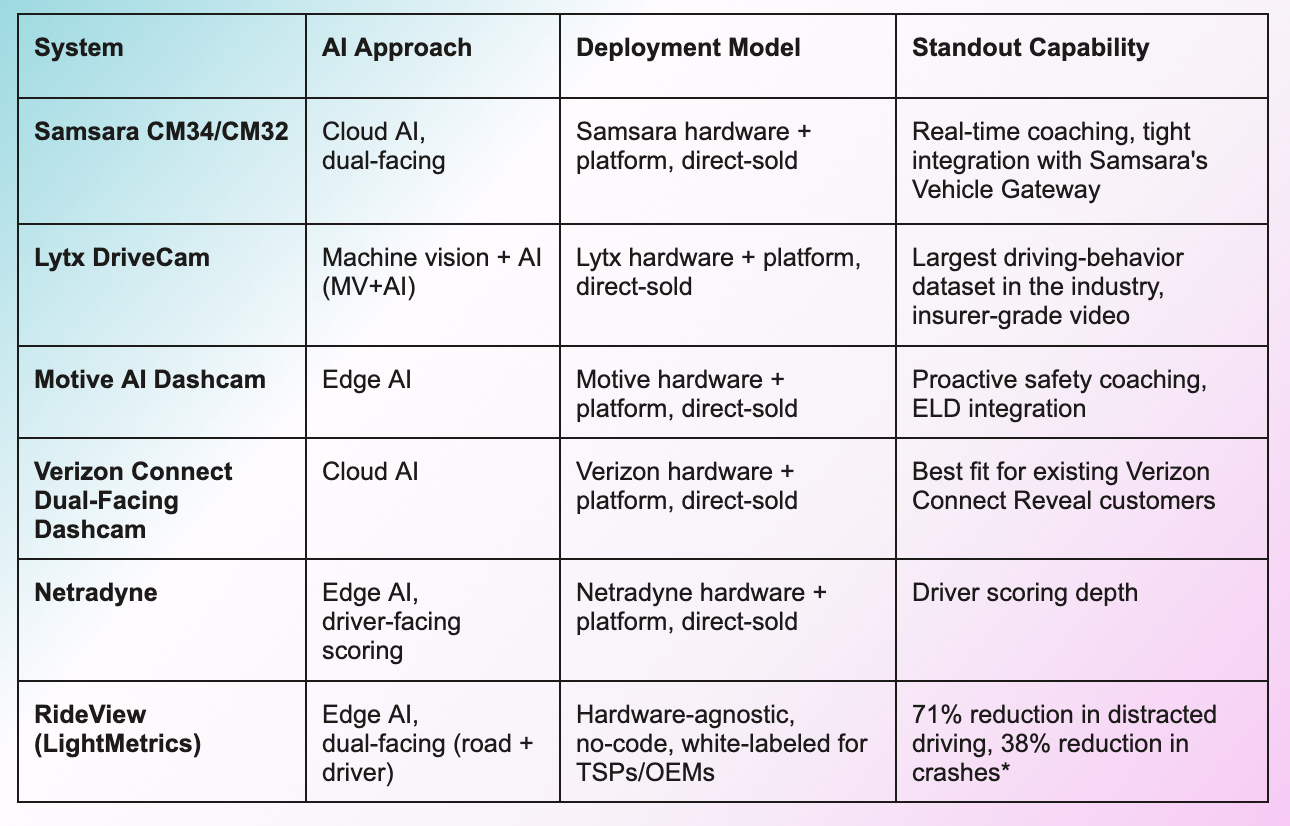
*Comparison methodology: Information was reviewed using publicly available product materials and company-published reports as of July 2026. Performance results are not directly comparable because vendors may use different fleet samples, measurement periods and methodologies.
Each name above has earned its place in the conversation, and that includes LightMetrics: many of the largest fleets in the world run their safety operations on RideView, whether through their telematics provider or directly integrated into their vehicles. The real differences between these systems show up less in the feature lists and more in how each platform fits the way your operation actually runs.
What Are Samsara, Lytx, Motive, and Verizon Connect Best At?
Give credit where it's due. Samsara's dual-facing AI dash cams have real, published results: crash rates dropping roughly 75% over 30 months across a large fleet sample, harsh events down nearly 48% in the first six months, and mobile phone use down 84%. Lytx has spent over a decade building one of the largest driving-behavior datasets in the industry, which shows up in how confidently its models catch risk. Motive and Verizon Connect both lean into deep platform integration, ELD compliance for Motive, and Reveal-ecosystem lock-in for Verizon. If you're a single fleet that's already standardized on one of these platforms, and you don't need channel flexibility, these are legitimate choices.
RideView holds its own on this list, with internal fleet analysis showing major gains in driver safety through fewer distracted driving incidents and a meaningful reduction in crashes, which is part of why many of the world's largest fleets run their safety operations on it.
Where the Comparison Breaks Down for TSPs, OEMs, and Multi-Brand Fleets
Here's the operational reality none of the five systems above solve: they're built to be sold once, by one company, on one brand. If you're a Telematics Service Provider trying to add video to your existing telematics offering, or a trucking OEM trying to bundle safety tech into your vehicles, adopting any of them means either reselling someone else's brand (channel conflict with your own name) or building your own stack from scratch (quarters of engineering time you don't have).
RideView was built for exactly this need. Its edge AI video telematics, analyzing both road-facing and driver-facing cameras to catch distraction, drowsiness, tailgating, and speeding, then coaching drivers in the cabin before those moments become incidents. Based on an internal analysis of RideView-equipped fleet data, fleets running the platform see a 71% reduction in distracted driving and a 38% reduction in crashes, results that stand up against any dual-facing AI system on this list.
The differentiator that doesn't show up in a feature checklist is how it gets deployed:
- No-code, hardware-agnostic. Partners choose from dash cameras across price points and get the same UX, backend, and APIs no matter which hardware they pick. No re-engineering when a hardware vendor changes pricing or goes end-of-life.
- White-labeled, no channel conflict. TSPs and OEMs launch a fully rebranded, fully supported solution under their own name. LightMetrics doesn't sell direct to fleets, so partners never compete with their own supplier.
- Weeks, not quarters. Because the AI, camera applications, firmware, diagnostics, cloud, and dashboards are all built in-house, partners integrate once and ship, instead of stitching together five vendors' worth of infrastructure.
- Built for scale. Diagnostics and device management are designed to handle thousands of cameras in the field, which matters the moment a rollout goes past a pilot fleet.
How Do Fleet Dash Cams Help with Claims Defence and Driver Exoneration?
Every system on this list will talk about crash prevention. Fewer talk about what happens after an incident. Dual-facing, on-demand video does double duty: it protects fleets and exonerates drivers who get hit with exaggerated or false claims, turning a "he said, insurance said" dispute into a settled question in minutes instead of months of litigation. That's not a feature. That's a line item on total cost of operations, and it's part of why a 38% drop in crashes (per our internal fleet analysis) translates directly into lower claims volume and fewer disputed incidents in the first place.
Which Fleet Camera System is Top-Rated?
- Buying for a single fleet, already locked into one telematics vendor? Samsara, Lytx, Motive, or Verizon Connect will serve you fine, pick based on whichever platform you already run on.
- A TSP or OEM trying to launch video telematics under your own brand, on your own timeline, without new channel conflict, and with results that match or beat the direct-sold platforms? That's the problem RideView was built to solve: a 71% reduction in distracted driving and a 38% reduction in crashes based on our fleet data, delivered on your hardware, under your brand, in weeks.
The "best" fleet camera system isn't the one with the most press releases. It's the one that matches how you actually go to market, backed by numbers that hold up. If that's white-labeled, hardware-flexible, fast to launch, and proven, the comparison isn't close.
Ready to see how RideView would work on your hardware, under your brand? Get in touch to book a demo and see why the fastest-growing TSPs aren't building video telematics from scratch.
