
How Commercial Fleets Prevent Tailgating Accidents
Explore how commercial fleets prevent tailgating accidents through safe following-distance policies, driver coaching, real-time AI alerts, and video review that reduces risk and costs.
Rear-end crashes are a common and costly problem for commercial fleets, and many start with one habit: following too closely. For commercial fleets, tailgating is a daily risk that plays out across many drivers at once. Learning how commercial fleets prevent tailgating accidents is the first step toward safer roads and lower costs.
A single rear-end crash can injure a driver, damage a vehicle, stall a delivery, and trigger an expensive claim. When the pattern repeats across a fleet, those costs pile up quickly.
This guide explains what tailgating is, why it is riskier for heavy vehicles, and what a safe following distance looks like. Then it walks through the clear policy, data-driven coaching, real-time detection, and video review that keep fleet drivers at a safe distance.
What Tailgating Means for a Commercial Fleet
Commercial fleets prevent tailgating accidents by setting a clear following-distance policy, coaching drivers with real event data, using AI cameras that warn the driver the moment a gap gets too small, and reviewing video to confirm what happened. Together these steps catch risky behavior before it becomes a crash.
Tailgating means following too closely. It happens when a vehicle does not leave enough space to stop safely if the vehicle ahead slows or brakes. Following distance is the gap of time and space between your vehicle and the one in front.
For a single driver, tailgating is one bad moment. For a fleet, it is a repeatable behavior that shows up across many drivers and routes. That makes it a habit a fleet can coach and correct.
The stakes are high. Following too closely leads to rear-end collisions, insurance claims, vehicle downtime, and legal liability. Most of all, it puts drivers and the public at risk.
Why Tailgating Is More Dangerous for Heavy Vehicles
A loaded truck is far heavier than a passenger car, so it needs much more room to stop. The heavier the vehicle, the longer it takes to slow down once the brakes are applied.
Stopping has two parts. First comes reaction time, the moment between seeing a hazard and pressing the brake. Then comes braking distance, the space the vehicle covers while it actually slows to a stop.
A short gap removes the buffer a driver needs for both parts. When a heavy vehicle follows too closely, there may not be enough road left to react and brake in time. That is why an unsafe gap is more dangerous for large vehicles, and why catching it early matters so much.
What a Safe Following Distance Looks Like
Fleets need a simple rule that every driver can apply on any road. The goal is a gap large enough to react and stop, even when the vehicle ahead brakes hard.
Two common methods make this easy to teach and easy to check.
The Few-Seconds Rule
Pick a fixed marker on the road, such as a sign or an overpass. When the vehicle ahead passes it, start counting. You should be able to count a few seconds before your own vehicle reaches the same spot.
If you reach the marker sooner than that, you are too close and should ease off. Add extra time in rain, snow, fog, or when the vehicle is heavily loaded, because stopping takes longer in those conditions.
The Following Distance Rule for Large Vehicles
Commercial drivers use a seconds-based gap that grows with the size of the vehicle. The longer and heavier the vehicle, the more seconds a driver should leave in front.
The Federal Motor Carrier Safety Administration tells truck drivers to add time for every additional length of the vehicle. Higher speeds call for even more, and bad weather and heavy loads call for a larger gap still.
This keeps the rule simple to remember while adjusting to real conditions.
Why Following Distance Is Hard to Manage at Fleet Scale
A safety manager cannot ride along with every driver on every trip. Without live data, tailgating stays invisible until a crash or a claim reveals it.
Several everyday pressures push drivers to close the gap:
- Schedule pressure: tight delivery windows tempt drivers to rush and crowd the vehicle ahead.
- Impatience: heavy traffic and slow lanes wear on drivers over a long shift.
- Overconfidence: experienced drivers may trust their reflexes more than the physics of stopping.
- Misjudging stopping distance: many drivers underestimate how much room a loaded vehicle really needs.
This visibility gap is the core problem. A fleet cannot fix a behavior it cannot see, which is exactly where video telematics helps.
How Commercial Fleets Prevent Tailgating Accidents
No single fix solves tailgating on its own. The reliable approach is a layered program that combines clear policy, data-driven coaching, real-time detection, and video review.
Each layer supports the next. Policy sets the standard, coaching builds the habit, detection catches the moment, and video confirms the facts.
Set Clear Following-Distance Policy
Start with a written following-distance standard so every driver knows what is expected. Spell out the seconds-based gap and when to add more time.
Back the policy with realistic schedules that do not force drivers to rush. Check the standard during hiring and ride-alongs so it is understood from day one. Policy sets the bar that the rest of a successful fleet safety program then enforces.
Coach Drivers With Data, Not Guesswork
Coaching works best when it is based on facts, not hunches. Driver scorecards and safety event data show which drivers tailgate often and on which routes.
With that data, a safety manager can coach the specific drivers who need it and skip guesswork. Make coaching routine and positive, focused on building safer habits rather than punishing mistakes. RideView driver coaching workflows turn tailgating events into a repeatable coach-and-verify loop, so the same behavior gets caught and corrected over time.
Use Detection and Real-Time In-Cab Alerts
Detection is what makes tailgating visible in the moment. Telematics is software that collects data from vehicles, and modern AI dash cams add a camera that watches the road ahead.
Edge AI is artificial intelligence that runs on the camera itself, instead of sending video to the cloud first. A forward collision warning is an alert that fires when the vehicle ahead is getting too close too fast. An in-cab alert is a sound or spoken warning inside the cabin that tells the driver to back off.
The difference between reviewing footage later and warning the driver now is large:
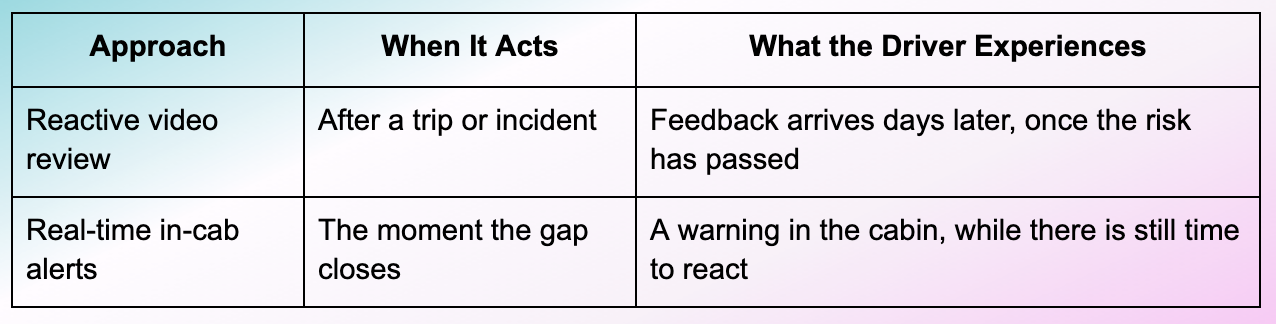
RideView edge AI detects forward collision risk and tailgating, then alerts the driver in the cabin before a rear-end collision happens. Because the AI runs on the camera, it works across a mixed camera fleet with one backend and one experience.
Fleets get RideView through their telematics service provider or vehicle manufacturer, so it fits the cameras and dashboards they already use. In-vehicle features like automatic emergency braking add another layer of protection alongside these alerts. Automatic emergency braking brakes the vehicle on its own when a crash is about to happen.
Use Video to Verify and Protect Drivers
Alerts prevent many incidents, and video explains the ones that still happen. On-demand video lets a safety manager pull footage of a specific event and see exactly what occurred.
That video supports fair coaching, because the driver and manager review the same clear record. It also protects drivers in disputed rear-end incidents, where footage can exonerate a driver who was following at a safe distance. RideView on-demand video protects both the fleet and the driver when a claim is on the line.
The Business Case for Preventing Tailgating
Preventing tailgating is a smart financial move as well as a safety one. Fewer rear-end collisions mean fewer claims and less insurance exposure.
Fewer crashes also mean less vehicle downtime and lower repair costs, so more of the fleet stays on the road earning revenue. Safer driving helps retain good drivers and protect the company's reputation with customers and the public.
Safety protects people, and it also protects the bottom line. Lower total cost of operations is the payoff for a fleet that takes following distance seriously.
Tailgating is a preventable behavior, not an unavoidable cost of running a fleet. With clear policy, data-driven coaching, real-time detection, and honest video review, fleets can close unsafe gaps before they turn into crashes.
The fleets pulling ahead are the ones adopting edge AI that catches a risky gap in the moment and coaches the driver right away. Preventing the collision is always better than paying for it, and the technology to do that is here today.
Bring Real-Time Tailgating Prevention To Your Fleet
RideView brings edge AI detection, real-time in-cab alerts, driver coaching workflows, and on-demand video into one platform. Fleets get it through their telematics provider or vehicle manufacturer, across the cameras they already run.
See how RideView can help your drivers keep a safe following distance and protect your fleet from rear-end claims. Request a demo to get started.
Frequently Asked Questions
What is a safe following distance for a commercial vehicle?
A safe following distance leaves enough room to stop even if the vehicle ahead brakes hard. It grows at higher speeds and in bad weather.
What is the following distance rule for large trucks?
Large trucks use a seconds-based gap that grows with the length and weight of the vehicle. Drivers add more time at higher speeds and in poor conditions.
What is the seconds rule for following distance?
Watch the vehicle ahead pass a fixed marker, then count the seconds until you reach the same spot. Aim for a few seconds, and more in bad weather.
Why do heavy trucks need more stopping distance than cars?
Heavy trucks weigh much more than cars, so they take longer to slow down. They need extra room to stop safely.
How does an AI dash cam detect tailgating?
An AI dash cam uses a road-facing camera and edge AI to measure the gap to the vehicle ahead. It sounds an in-cab alert when that gap becomes unsafe.
What causes fleet drivers to tailgate?
Common causes include schedule pressure, impatience in traffic, overconfidence, and simply misjudging how much room a loaded vehicle needs to stop.
