
How Video Telematics Detects Drowsy Driving
Video telematics uses in-cab computer vision to detect drowsy driving before accidents occur. See how this technology protects commercial fleets.
How Video Telematics Detects Drowsy Driving
Video telematics detects drowsy and distracted driving by using in-cab computer vision to map a driver's facial landmarks and head position in real time. The system calculates gaze deviation and eyelid closure duration, triggering an immediate audible alert when these metrics cross predefined safety thresholds. This prevents collisions by intervening before a driver loses control.
Commercial fleets face a persistent vulnerability when drivers operate heavy vehicles under fatigue or cognitive distraction. Traditional safety programs rely on reactive measures, meaning safety managers only learn about a driver's compromised state after a collision or critical incident has already occurred. The risk exists continuously, but visibility into that risk remains fragmented across the organization.
The problem persists because standard tracking methods monitor the vehicle rather than the operator. GPS data and basic dashcams capture harsh braking or sudden swerves, but these are lagging indicators of a distracted event that began seconds earlier. By the time the vehicle's physics reflect a problem, the opportunity to prevent an accident has already passed.
How Do AI Dash Cams Identify Driver Distraction?
AI dash cams use edge-based computer vision to continuously analyze a driver's head pose and eye gaze for inattentiveness. The system processes video frames locally to calculate the distance between facial landmarks, triggering an in-cab auditory warning if the driver's focus deviates from the road for more than three seconds. Because the analysis happens on the device itself, the warning prompts immediate course correction without waiting on a round trip to the cloud.
To detect drowsiness signs like yawning and eye closing, the system relies on neural networks trained on millions of driving hours. The algorithms map the geometry of the face, tracking the aspect ratio of the eyes and the openness of the mouth. Rather than relying on eye closure alone, modern detection models evaluate eye openness alongside blink rate, blink duration, and the statistics derived from these measurements. Combining multiple signals makes it possible to flag fatigue at its earliest stages, well before a driver's eyes actually close, while keeping false alarms to a minimum.
The technology also distinguishes between a driver adjusting the radio and texting by tracking the duration of the downward gaze and the specific hand positioning. A quick glance at the console falls within normal operational thresholds, whereas sustained downward focus combined with a hand holding an illuminated object triggers a distracted driving alert. The main indicators of driver distraction that video telematics AI is trained to identify include mobile phone usage, smoking, eating, and prolonged gaze deviation.
What Does Active Distraction Detection Look Like in Practice?
Active distraction detection refers to systems that intervene the moment risky behavior appears, rather than simply recording footage for later review. These systems monitor real-time operator behavior inside commercial vehicle cabins, identifying cognitive disengagement and physical fatigue and preventing catastrophic accidents through immediate in-cab feedback and remote telemetry logging.
Rather than waiting for a dramatic failure, active systems work by catching fatigue early. Take a driver six hours into an overnight run who is on the verge of experiencing microsleeps. His eyes are technically still open, but his blink rate has slowed, individual blinks are stretching longer than normal, and his head has started to dip forward. Nothing about the vehicle's movement has changed yet, so GPS tracking and a forward-facing camera would register a perfectly normal trip.
An active in-cab system reads this pattern differently. Because it evaluates eye openness, blink rate, and blink duration together, it recognizes the early signature of drowsiness before the eyes ever fully close. A sharp, audible alert sounds inside the cab, prompting the driver to re-engage, and the event is automatically logged to the fleet manager's dashboard for future coaching. The intervention happens at the behavioral level, before there is a lane drift or hard brake for anyone to react to.
Accuracy matters just as much as speed here. Drowsiness is one of the most difficult behaviors to detect reliably, and false alarms erode trust on both sides: drivers feel unfairly flagged, and safety managers waste hours reviewing events that were never risky. Newer platforms address this with a second layer of intelligence in the cloud, such as LightMetrics' ΦFP, which re-examines every event flagged by the camera with a more powerful AI model before it reaches the coaching queue. In early deployments, this cloud verification lifted drowsiness detection precision from 94% to over 99%, meaning the alerts that reach a manager are ones that genuinely warrant attention.
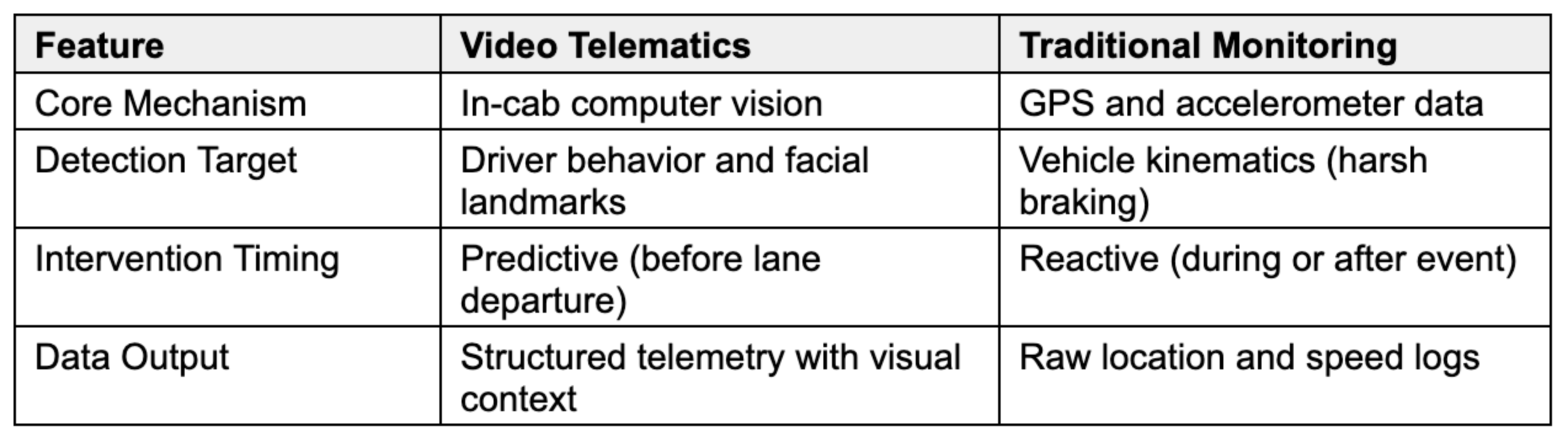
How Does Video Telematics Compare to Traditional Monitoring?
Video telematics evaluates driver state using localized neural networks, whereas traditional monitoring relies on lagging kinematic data. This shift from reactive vehicle tracking to proactive behavioral analysis reduces collision rates by addressing the root cause of the incident.
Evaluating Distracted Driving Alerts
- Gaze Deviation < 2 seconds = NORMAL. Action: System ignores the movement.
- Gaze Deviation > 2 seconds AND hands off wheel = HIGH RISK. Action: Trigger audible in-cab alert.
- Eyelid Closure > 1.5 seconds = CRITICAL FATIGUE. Action: Trigger maximum volume alert and dispatch notification.
- Yawning Frequency > 3 times per 15 minutes = MODERATE FATIGUE. Action: Log event for manager review.
Ready to move from reactive tracking to proactive prevention? Discover how active monitoring tools can secure your operations.
What Are the Trade-Offs of Adopting Video Telematics?
Video telematics requires specific operational conditions to maintain accurate detection rates. Environmental factors and hardware limitations degrade the algorithm's ability to map facial landmarks effectively if not managed properly.
- Less effective when the driver wears heavily mirrored or reflective glasses that fully conceal the eyes from the camera, since the system must rely on head and posture cues alone.
- Not suitable when the camera lens is physically blocked or misaligned by the operator.
- Not suitable when the vehicle cabin lacks a stable mounting surface, causing excessive vibration that blurs the video frames.
- Not suitable when the organization lacks a clear data privacy policy regarding in-cab recordings.
How Can Fleets Start Exploring Telematics Solutions?
Exploring video telematics starts with assessing current safety vulnerabilities and aligning them with the right detection capabilities. Fleet managers use this technology to build proactive safety cultures and reduce overall liability.
Understanding the capabilities of AI-driven safety tools is the first step toward reducing fleet risk. Evaluate your current incident rates and identify where behavioral monitoring could bridge the gap between passive tracking and active accident prevention. From there, outline your specific operational requirements and compare platforms that align with your safety goals.
Quick Answers for Fleet Managers
What are the technical prerequisites for installing an AI dash cam?
Installing an AI dash cam requires a constant power source from the vehicle's OBD-II or J1939 diagnostic port. The hardware also needs a clear, unobstructed view of the driver's face and an active cellular connection to transmit telemetry data to the cloud dashboard.
How long does it take to see a return on investment from video telematics?
The timeline to see a return on investment varies based on fleet size, safety goals, baseline collision rates, and how the technology is rolled out. Many fleets begin to see measurable value within the first year as savings accumulate from fewer at-fault collisions, lower insurance premiums, and decreased wear and tear from harsh braking events.
How does an AI dash cam know if a driver is falling asleep versus looking at their phone?
The dash cam uses computer vision to map specific facial landmarks. Falling asleep triggers alerts based on eyelid closure duration and head nodding, while phone usage triggers alerts based on sustained downward gaze deviation and the presence of a hand-held device in the frame.
What are the main indicators of driver distraction that video telematics AI is trained to identify?
The AI is trained to identify prolonged gaze deviation, mobile phone usage, smoking, eating, and lack of seatbelt usage. It calculates the exact angle of the head and the duration of the inattentiveness to classify the severity of the distraction.
What events trigger an audible in-cab alert for a distracted or drowsy driver?
An audible in-cab alert triggers when the driver's eyes close for more than 1.5 seconds or their gaze deviates from the road for more than three seconds. The system issues a sharp warning sound to prompt immediate cognitive re-engagement.
