
Top Video Telematics Solutions: How to Choose the Right Platform for Your Fleet
Learn how to evaluate video telematics solutions, compare key features, and choose the right AI fleet camera platform to improve safety, coaching, and fleet performance.

Introduction
Every commercial fleet wants safer drivers and fewer accidents. The hard part is knowing which tools actually deliver that.
Search for the top video telematics solutions and you get long lists of brand names. What those lists rarely explain is what video telematics really is, or how to tell a strong platform from a plain camera.
This guide takes a different approach. Instead of ranking companies, it explains how the technology works and what separates a top-tier solution from a basic one.
You will learn what video telematics is, how it turns camera footage into real safety action, and the questions to ask before you buy. By the end, you can judge any solution on its merits and match it to your fleet.
What Is Video Telematics?
Video telematics is technology that pairs vehicle cameras with GPS and vehicle data, then uses software to understand what is happening on the road and in the cab. It links what a camera sees to how a vehicle is being driven, so a fleet can spot risk and act on it.
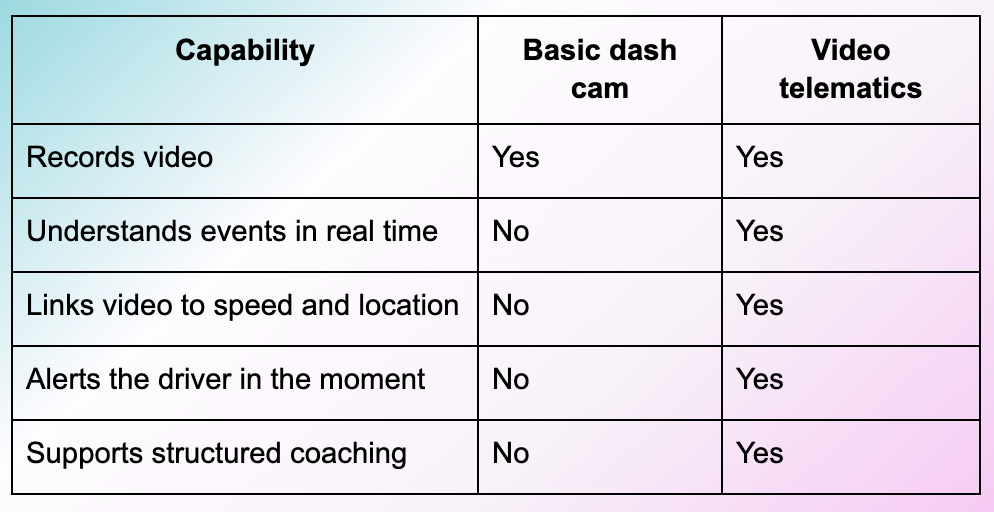
A basic camera only records video for someone to watch later. Video telematics goes further. It reads events as they happen and connects them to speed, location, and driving behavior.
The intelligent layer that makes this possible is edge AI. Edge AI means the software runs on the camera itself, so it can analyze what it sees right away instead of waiting for a person to review footage. This is what turns a camera into a real-time fleet camera system and a true AI dash cam, which is a camera that can recognize risky driving on its own.
Video Telematics vs. a Basic Dash Cam
A basic fleet dash cam is a recorder. It captures the road, saves the file, and waits for a manager to scrub through hours of video after something goes wrong.
A video telematics solution understands events while they happen and ties them to vehicle data. It knows the difference between hard braking in traffic and a near collision, and it can act in the moment.
Here is how the two compare:
The Core Parts of a Video Telematics System
A video telematics system is built from a few working parts.
- Cameras: A road-facing camera watches the road ahead, and a driver-facing camera (often called a driver safety camera) watches the cab for signs of distraction or drowsiness.
- Edge AI device: This is the processor that analyzes footage on the vehicle and decides what counts as a risky event.
- Connectivity: A cellular connection sends flagged events and video to the cloud.
- Cloud platform: This is where events, trips, and video are stored and organized for review.
- Manager dashboard and driver app: The dashboard is where a safety team reviews events and runs coaching, and the driver app gives drivers visibility into their own performance.
Together these parts turn a fleet camera system into a full safety program rather than a set of recorders.
How Video Telematics Works
Video telematics works in a chain that starts on the road and ends with a coached driver. Each step builds on the one before it.
First, the cameras and sensors capture the road and the cab. Second, edge AI on the device analyzes that footage as it happens.
When the AI spots something risky, it does two things at once. It warns the driver in the cab, and it uploads the event to the cloud with the context around it, such as speed and location. A manager then reviews the event and uses it to coach.
The result is an AI dash cam that does more than record. It helps a fleet act before a small risk becomes a crash.
Edge AI vs. Cloud Processing
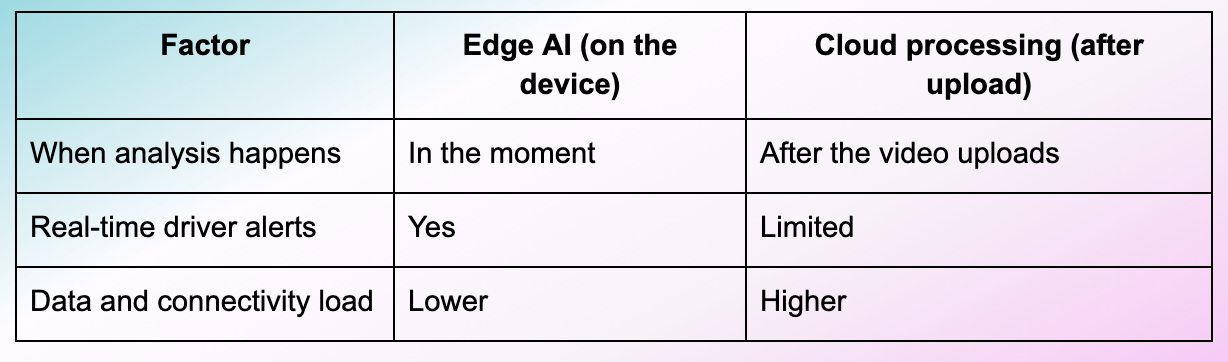
Where the analysis happens changes what a solution can do. There are two main options, and the difference matters. Edge AI runs on the camera itself. Because the work happens on the device, the system can warn a driver the instant it sees a problem.
Cloud processing works differently. The camera sends raw video up to a server, and the analysis happens after the upload. That delay makes real-time warnings hard, and moving all that video can raise data and connectivity costs.
From Alert to Driver Coaching
An edge AI alert is only the first step. The real value comes from what happens next. When the system flags an event, it gives the driver an in-cab warning right away. That warning is a gentle nudge to correct course, such as looking back at the road.
The same event then becomes a coaching moment for the safety team. A manager can review the clip with the driver, talk through what happened, and reinforce better habits. This is the model behind RideView, where real-time in-cab coaching is built to prevent incidents rather than only record them.
What Makes a Video Telematics Solution "Top-Tier"?
The top video telematics solutions are not defined by a brand name. They are defined by a set of capabilities that a fleet or provider should demand.
Think of the search for top video telematics solutions as a checklist rather than a ranking. When you compare video telematics companies and video telematics providers, the criteria below are what actually separate a strong platform from a basic one.
Real-Time AI and Accurate Event Detection
The core job of any AI dash cam is to catch risk accurately. Strong solutions detect distraction, drowsiness, tailgating, and speeding as they happen.
Accuracy is just as important as detection. A driver safety camera that cries wolf with false alerts loses driver trust fast. When alerts are accurate, drivers take them seriously and coaching sticks.
Hardware Flexibility and Avoiding Lock-In
Many platforms tie you to one proprietary camera. That locks you into a single device, a single price point, and whatever that vendor decides to charge later.
A flexible platform works across different cameras and price points instead. RideView takes this hardware-agnostic approach, with any camera running on one backend and one user experience. That protects the buyer and keeps options open as needs change.
Integration with Your Existing Telematics
Video is more useful when it sits next to your other fleet data. The best solutions offer APIs, which are the connections that let two software systems share data, so video can join your vehicle and GPS information in one place.
That means a manager sees fleet telematics and video together on a single dashboard. Pairing video with telematics vehicle tracking removes the need to jump between separate tools to understand one event.
Deployment, Support, and Device Management at Scale
A solution is only as good as your ability to roll it out and keep it running. Easy installation and automatic calibration mean cameras go live quickly without a specialist for every vehicle.
Support and device management matter even more as a fleet grows. Strong platforms offer remote diagnostics and over-the-air updates, which are software updates sent to the device without a shop visit. RideView is built to handle large field deployments with self-installation and this kind of device management.
Driver Privacy and Trust
In-cabin cameras raise real concerns for drivers. If drivers feel watched without a say, adoption stalls and the program struggles.
Top solutions treat privacy as a design choice. Giving drivers control and clear policies improves trust, drives adoption, and helps a fleet meet regional rules. RideView follows a privacy-by-design approach so drivers keep control of their data.
Who Uses Video Telematics, and How It's Delivered
Video telematics serves two related groups. There are the fleets and safety teams who use it every day, and there are the providers who deliver it to them.
Understanding both groups matters, because it shapes a key decision for anyone entering this market: build a solution from scratch, or adopt one that already works. The video telematics providers and video telematics companies you compare will fall on one side of that choice.
Fleets and Safety Teams
Commercial fleets use video telematics to make daily operations safer. They prevent accidents by coaching risky habits before they cause harm.
The benefits reach beyond safety. When an incident does happen, on-demand video can exonerate a driver who was not at fault and help fight exaggerated claims. A commercial fleet dash cam program can also lower operating costs through fewer accidents and less vehicle downtime.
TSPs, OEMs, and Resellers (Build vs. Buy)
Some organizations do not run fleets themselves. They serve fleets. These include Telematics Service Providers, or TSPs, which are companies that offer fleet tracking and management software, and OEMs, the vehicle manufacturers that build trucks and equipment.
These providers face a choice. They can build a video telematics product from scratch, which means creating the AI, hardware ecosystem, and backend themselves over many quarters. Or they can adopt a rebrandable platform and launch under their own brand much faster, without channel conflict.
RideView is built for that second path. It gives TSPs and OEMs a no-code, rebrandable way to launch their own smart video telematics solution quickly, so they can serve fleet customers without building everything themselves.
How to Choose the Right Video Telematics Solution
Choosing among video telematics solutions is easier when you follow a clear process. The goal is to match a platform to your fleet or your customers' fleets, not to chase the longest feature list.
Start by defining your goals. Decide whether your priority is fewer accidents, driver exoneration, lower costs, or all of them, because that shapes what to weigh most.
Then work through the fit. Check that the hardware and integration match what you already run, and weigh the total cost of operation rather than the sticker price alone. Test the support you would actually receive, and plan a rollout you can manage at your fleet's size.
Use this short checklist when you evaluate the top video telematics solutions.
- Detection quality: Does the AI catch real risk with few false alerts?
- Hardware flexibility: Can it run on more than one camera and price point?
- Integration: Does it connect with your existing telematics and GPS data?
- Deployment and support: Is installation simple, and is help there when you scale?
- Privacy: Does it give drivers control and meet your regional rules?
The right answer is the solution whose capabilities fit your needs, not the one with the loudest name.
Frequently Asked Questions
What is the difference between telematics and video telematics?
Telematics tracks vehicle data like location, speed, and engine health, while video telematics adds cameras and AI so you can see and understand driving events alongside that data.
Are driver-facing cameras legal for commercial fleets?
Driver-facing cameras are generally legal for commercial fleets in the United States, though rules on notice and consent vary by state, so a privacy-by-design solution that gives drivers control makes compliance easier.
Do video telematics cameras work in the dark?
Yes, most fleet cameras use infrared or low-light sensors so they can capture the road and the cab clearly at night and in poor visibility.
How hard is it to install a video telematics system?
Modern systems are designed for self-installation with automatic calibration, so a fleet can often mount and activate cameras without a specialist for every vehicle.
Can video telematics integrate with my existing GPS tracking?
Yes, strong platforms offer APIs that connect video with your existing GPS and telematics data, so you can view everything on one dashboard instead of separate tools.
What is edge AI in a dash cam?
Edge AI in a dash cam is software that analyzes footage on the camera itself rather than in the cloud, which lets the device warn a driver about risk the moment it happens.
In summary, the top video telematics solution is not a single brand. It is the platform whose capabilities fit your fleet or the fleets you serve. As you compare options, look for the markers that matter. Real-time edge AI, hardware flexibility, deep integration, and driver trust tell you far more than a place on a list. Video telematics is moving from recording the past toward preventing the next incident. Solutions built on real-time AI put that prevention in reach, and choosing on capability is how you get there.
See how RideView delivers hardware-agnostic edge AI video telematics for fleets, and how it helps TSPs and OEMs launch their own branded solution fast. Request a demo to walk through real-time coaching, flexible camera options, and device management built for scale.
